The Architecture of Aliveness: Reciprocity, Sovereignty, and the Systems That Let Life Breathe
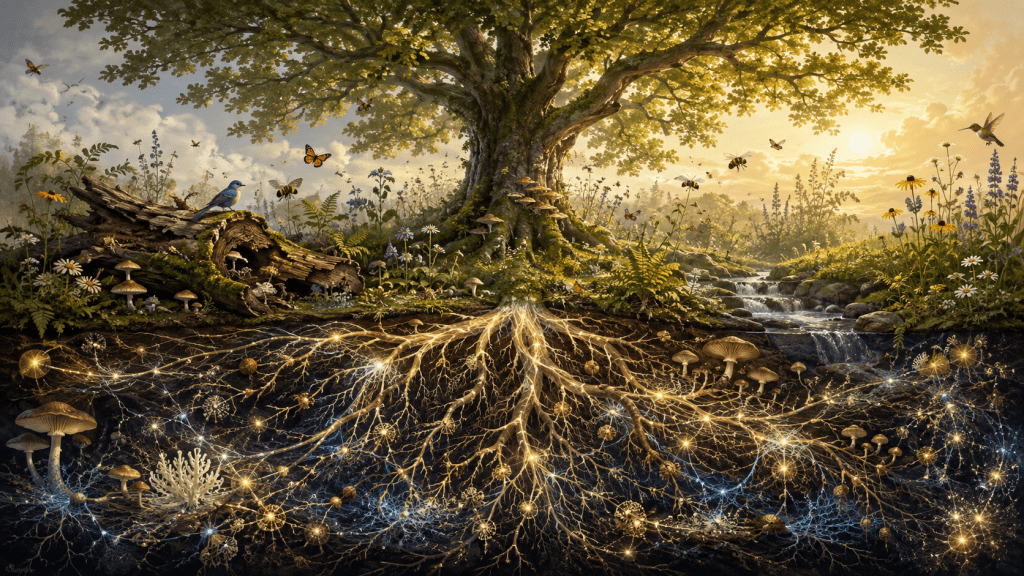
How relationship, language, contrast, and reciprocity turn consciousness into form
We live in a culture obsessed with outcomes.
What did you build?
What did you achieve?
What did you acquire?
What did the relationship become?
Did the idea work?
Did the investment pay off?
But beneath every outcome is a quieter question:
What kind of architecture allowed that outcome to exist in the first place?
A forest does not survive because one tree works harder than the others. A body does not thrive because one organ compensates forever for the dysfunction of the rest. A relationship does not become healthy because one person is more emotionally intelligent, more generous, more organized, more self-aware, or more willing to carry what no one else will.
Living systems endure through circulation.
Energy moves.
Resources move.
Information moves.
Care moves.
Responsibility moves.
Power moves.
And when those things stop circulating, systems begin to distort.
The organism that gives indefinitely without receiving is eventually depleted.
The organism that receives indefinitely without contributing becomes dependent on extraction.
The family member who carries everyone else’s emotional labor may be praised as “the strong one” while quietly being sacrificed to maintain the appearance of harmony.
The employee who constantly compensates for dysfunctional systems becomes indispensable and exhausted at the same time.
The partner who anticipates every need eventually becomes the infrastructure of the relationship rather than one of its participants.
And sometimes we call this love.
Sometimes we call it loyalty.
Sometimes we call it being a good daughter, a good mother, a good employee, a good partner, a good person.
But a system that requires one organism to continually subsidize the whole is not reciprocal simply because everyone has become accustomed to the arrangement.
The old confusion between love and control
Many people learn love through channels that are also used to control them.
Provision can become leverage.
“I pay for everything, therefore I decide.”
Care can become leverage.
“After everything I’ve done for you, you owe me.”
Emotional vulnerability can become leverage.
“Look what you made me feel.”
Silence can become leverage.
“I will withdraw until you become uncomfortable enough to comply.”
Affection can become leverage.
“I will give closeness when you behave correctly and remove it when you don’t.”
The tragedy is that the original channel may still register as love.
A person can deeply value provision while fearing dependence because provision once came with authority.
Another can deeply value care while fearing dependence because care once came with obligation.
So adulthood becomes a strange paradox:
we long for the very forms of support we learned not to trust.
And many people solve this by becoming fiercely independent.
They stop needing.
They stop asking.
They become competent enough to ensure nobody will ever hold survival, comfort, belonging, or stability over their heads again.
It works.
Until love arrives.
Because intimacy eventually requires something independence cannot provide:
the ability to receive without surrendering sovereignty.
That is a different skill.
Dependency is not the enemy
The opposite of codependence is not invulnerability.
Human beings are interdependent organisms.
We depend on farmers we will never meet.
We depend on microbes living inside our bodies.
Trees exchange nutrients with fungi.
Pollinators expend energy feeding themselves while simultaneously transporting reproductive material across entire ecosystems.
Infants require adults.
Adults require communities.
Bodies require environments.
No organism is entirely self-generated.
The real question is not whether dependence exists.
It is:
What happens to power when dependence appears?
Healthy interdependence says:
I can need you without becoming owned by you.
You can help me without acquiring authority over me.
I can care for you without creating an invoice.
You can receive from me without becoming indebted.
We can affect one another without becoming responsible for controlling one another.
That is a radically different architecture from either enmeshment or extreme independence.
It is relationship without captivity.
Contrast may be one of nature’s oldest creative technologies
Nature is full of reproductive strategies.
Sexual reproduction.
Asexual reproduction.
Parthenogenesis.
Hermaphroditism.
Sequential sex change.
Budding.
Cloning.
Bipotential developmental structures that later differentiate.
Life does not appear committed to one simplistic model of generation.
It experiments.
It recombines.
It differentiates.
It returns variation into the field.
One of the most interesting questions in evolutionary biology is why sexual reproduction exists at all when asexual reproduction can be more efficient.
Sex is expensive.
It requires another organism.
Only part of each parent’s genome is transmitted.
Finding mates consumes energy.
And yet sexual reproduction persists.
Why?
One major advantage is recombination.
Difference produces novelty.
The point is not merely replication.
Life gains adaptive possibility by mixing what was previously separate.
That principle extends far beyond biology.
Two perspectives can produce an idea neither held independently.
Two cultures can generate a new artistic language.
Two disciplines can reveal something neither could see from inside its own assumptions.
Two people with different nervous systems can expose strengths and weaknesses invisible to each other alone.
Difference is not automatically incompatibility.
Sometimes difference is creative raw material.
The problem begins when difference becomes hierarchy.
When one form declares itself superior.
When one mode of perception claims authority over all others.
When contrast becomes conquest instead of collaboration.
Healthy systems do not require every organism to become the same species of intelligence.
A forest would collapse if every organism tried to become a tree.
Light, sound, word, form
Across spiritual traditions, philosophy, and science, human beings have repeatedly returned to a similar sequence.
First there is perception.
Then vibration.
Then articulation.
Then form.
Ancient Egyptian mystical traditions place enormous emphasis on luminous consciousness: awareness recognizing something deeper than the personality moving through ordinary life.
Sufi philosophy has long explored existence through sound, rhythm, harmony, and vibration.
Christian mystical traditions have treated the spoken word as generative: language does not merely describe reality; it participates in shaping human experience.
Yorùbá cosmology contains sophisticated conceptions of generative power, creation, destruction, social organization, motherhood, spiritual force, and the capacity to shape existence itself.
These traditions do not need to be collapsed into one religion to notice the philosophical pattern:
awareness perceives. resonance connects. language differentiates meaning. action gives meaning form.
This sequence happens constantly.
Someone senses discomfort before knowing why.
Then the nervous system vibrates with it.
Then language arrives:
“I feel excluded.”
“I need space.”
“I want more.”
“I don’t agree.”
“I’m afraid.”
“I love you.”
Those words change the relational field because they introduce information that did not exist there before.
The other person can now respond to reality instead of guessing.
From that exchange, structure can emerge:
a boundary.
an agreement.
a schedule.
an apology.
a commitment.
a refusal.
a changed behavior.
This is how consciousness becomes architecture.
Silence is not always peace
Many families maintain harmony through silence.
One person absorbs conflict.
One person never expresses anger.
One person becomes the emotional regulator.
One person learns never to need anything.
One child becomes mature beyond their years because the adults around them cannot regulate themselves.
From the outside, the family may look stable.
Inside, somebody is paying the bill.
This pattern scales.
Organizations do it.
Communities do it.
Cultures do it.
Relationships do it.
We often confuse the absence of visible conflict with health.
But suppressed information does not disappear.
It becomes resentment.
Fatigue.
Illness.
Withdrawal.
Explosions that appear to come from nowhere.
Generational repetition.
The question is not whether a system appears peaceful.
It is:
Who is being sacrificed to maintain that peace?
Truth can temporarily disturb harmony while protecting the life underneath it.
Counterfeit harmony protects the structure while sacrificing the organism.
The danger of overengineering life
Human intelligence is remarkable because it allows us to model reality before acting.
We anticipate.
Plan.
Measure.
Predict.
Design.
Those abilities protect us.
But every gift has a point where its own strength becomes distortion.
Planning becomes control.
Discernment becomes surveillance.
Boundaries become walls.
Self-sufficiency becomes isolation.
Care becomes management.
Insight becomes domination.
And eventually we can become so good at observing life that we stop participating in it.
This is the danger of mistaking the map for the territory.
A person can analyze every attachment pattern and still be terrified to love.
Study every trauma response and still avoid vulnerability.
Understand every spiritual symbol and still remain disconnected from the body.
Engineer every variable and accidentally suffocate the very life the structure was meant to support.
The purpose of a rib cage is to protect the lungs.
It does not protect them by preventing them from expanding.
Good architecture creates enough safety for movement.
A bridge does not determine where a traveler must go.
It simply makes crossing possible.
A harness does not remove height.
It creates enough protection for someone to move through it.
A boundary should work the same way.
So should commitment.
So should community.
Structure exists to support life.
Life does not exist to preserve structure.
The observer must eventually return to the body
Modern consciousness has become extraordinarily skilled at observation.
We watch ourselves thinking.
We analyze our childhoods.
Track our nervous systems.
Interpret our relationships.
Study our personalities.
Monitor our performance.
There is value in this.
But there is also a threshold where self-awareness becomes self-separation.
The observer becomes so dominant that the participant disappears.
One can become endlessly aware of life without actually inhabiting it.
True integration requires return.
The body.
Food.
Sleep.
Work.
Touch.
Laughter.
Sex.
Grief.
Children.
Friendship.
Movement.
Ordinary conversation.
The spiritual question may not be:
How far beyond the body can consciousness travel?
It may be:
How much consciousness can remain present while fully inhabiting a body?
Expansion without return becomes fragmentation.
Awareness without embodiment becomes exile.
The goal is not to escape being human.
It is to become more fully present inside humanity.
Reciprocity is not identical exchange
Healthy reciprocity does not mean every contribution must be numerically equal.
A forest does not keep a spreadsheet.
Different organisms contribute differently.
One brings nutrients.
Another decomposes waste.
Another provides shade.
Another pollinates.
Another controls population.
Another creates habitat after death.
Equality does not require identical function.
But health does require circulation.
Over time, everyone cannot continuously draw from the same source.
A healthy relationship may include periods when one partner earns more.
One carries more childcare.
One needs more emotional support.
One is sick.
One is grieving.
One has more capacity.
The question is not whether imbalance ever exists.
It is:
Does the system naturally seek rebalancing, or does imbalance become its permanent operating model?
That is the difference between support and sacrifice.
Care should not become currency
One of the most radical forms of love is clean generosity.
Here.
This is for you.
No hidden contract.
No future weaponization.
No moral debt.
No demand that the receiver become smaller because they accepted something.
The same is true of provision.
Providing for someone does not grant ownership.
Paying does not confer sovereignty.
Helping does not create hierarchy.
And receiving does not automatically create weakness.
The deeper task is learning to exchange resources without converting resources into power over another person.
That applies to:
money,
time,
attention,
emotional labor,
sex,
housing,
knowledge,
status,
caregiving,
access,
and affection.
What matters is whether the gift remains a gift after it is given.
Words can become bridges or weapons
Language creates relational reality.
Not because saying something magically guarantees an outcome, but because language changes what information exists inside a system.
“I need time” creates a different experience than disappearing.
“I’m angry” creates a different experience than punishment.
“I would have liked to be included” creates a different experience than silent resentment.
“No” creates a boundary.
“Yes” creates permission.
“I was wrong” creates the possibility of repair.
“I don’t know yet” creates honest ambiguity.
“I love you” creates exposure.
Words do not control what happens next.
They make reality available for response.
That distinction is everything.
Healthy communication is not using language to compel another person into the desired outcome.
It is using language to make one’s internal reality legible while leaving the other person free.
Expression without colonization.
The deepest form of power may be participation
There is an old fantasy of power that imagines mastery as total control.
Control the body.
Control nature.
Control uncertainty.
Control other people.
Control the future.
Control emotion.
Control perception.
Control loss.
But living systems repeatedly undermine that fantasy.
No tree controls the forest.
No cell controls the body.
No organism controls evolution.
No partner controls relationship.
No parent controls the future adult their child will become.
Resilient systems do not survive because nothing unpredictable happens.
They survive because they can respond to change without losing their organizing integrity.
That suggests a different definition of power:
not command, but capacity.
Capacity to adapt.
Capacity to remain centered.
Capacity to receive information.
Capacity to repair.
Capacity to release what no longer works.
Capacity to tolerate difference.
Capacity to love without possessing.
Capacity to be changed without being destroyed.
This is sovereignty at its most mature.
Not:
nothing can affect me.
But:
I can be affected without surrendering authorship of myself.
The architecture of aliveness
Perhaps the deepest mistake humans make is confusing preservation with life.
We try to preserve identities.
Relationships.
Families.
Institutions.
Beliefs.
Bodies.
Roles.
But life itself survives through change.
Cells die.
Forests burn.
Skin sheds.
Relationships transform.
Cultures evolve.
Children separate.
Bodies age.
Ideas collapse.
New structures emerge.
Life does not preserve itself by preventing transformation.
It preserves itself through its ability to metabolize transformation.
So perhaps the question is no longer:
How do we make everything safe enough that nothing changes?
Perhaps it is:
What kind of architecture allows change without unnecessary destruction?
Enough boundary to protect.
Enough openness to receive.
Enough structure to hold.
Enough space to breathe.
Enough individuality to choose.
Enough reciprocity to sustain.
Enough truth to correct the system.
Enough humility to update the model.
Enough mystery that life remains alive.
A corset can create beautiful structure while restricting breath.
A spine creates structure while allowing movement.
That may be the distinction worth carrying forward:
Burn the corset. Keep the spine.
Do not eliminate structure.
Refine it.
Do not eliminate need.
Remove coercion from it.
Do not eliminate difference.
Stop turning difference into hierarchy.
Do not eliminate uncertainty.
Build enough self-trust to remain present inside it.
Do not eliminate dependence.
Transform it into interdependence.
Do not eliminate power.
Ask what the power serves.
The strongest systems may not be those in which one organism becomes indispensable.
They may be those in which each organism retains its integrity while participating freely in the whole.
That is true in forests.
Families.
Bodies.
Communities.
Relationships.
Maybe even consciousness itself.
Life is not asking us to become less individual.
It may be asking us to become individual enough that connection no longer requires conquest.
And connected enough that sovereignty no longer requires isolation.
That is not perfect equilibrium.
It is living reciprocity.
A structure with lungs.
A system capable of breathing.
A form strong enough to hold life with an open palm rather than a closed fist.
Discover more from djonechain
Subscribe to get the latest posts sent to your email.


